Prince George’s County Clerk of Court is the central office for managing court records and supporting citizens in official legal matters. The office handles a variety of court services, including submitting court documents, processing civil and criminal filings, and maintaining public records. Residents often rely on the Clerk of Court when filing for marriage or divorce, requesting certified copies of documents, or verifying court information. By providing clear procedures and efficient processing, the office ensures that legal transactions are completed accurately and on time. Its role is vital for maintaining organized records, helping both the public and the judicial system stay informed and compliant.
The Clerk of Court office also acts as a guide for citizens navigating county legal administration. Beyond document submission, the office offers assistance with understanding filing requirements, verifying official records, and managing fees associated with legal processes. This includes handling marriage certificates, divorce decrees, civil case documents, and other official filings. With a focus on accessibility and efficiency, the office streamlines legal procedures, allowing residents to manage their court-related needs confidently. The office’s support ensures timely processing, reduces errors, and provides a reliable point of contact for all official court documentation.
What Is the Prince George’s County Clerk of Court?
The Prince George’s County Clerk of Court is a local government office that manages court administration and maintains official records for several types of cases. The Clerk of Court at Prince George’s County Court supports judges, attorneys, and the public by preserving accurate documentation and helping with legal procedures. As a key public records repository, this office ensures that court documents are available for review, retrieval, and certified copying when allowed by law.
History & Mission of the Office
The Clerk of Court office in Prince George’s County has roots that trace back to early county governance, where keeping reliable records was essential for both legal and civic matters. Over many decades, the office grew in its level of responsibility as the county’s courts expanded and more functions were added. Today, the mission centers on court administration, reliable record maintenance, and quality service to the public. This mission supports public trust and helps all participants in the justice system access information that matters for cases, legal rights, and personal matters such as marriage, divorce, or property disputes.
The office aims to:
- Maintain accurate, secure court files for civil, criminal, family, and traffic cases.
- Provide friendly support for people needing to submit documents or review records.
- Deliver prompt processing of filings and certified copies.
- Preserve historical and legal information for long‑term county use.
Organization and Oversight
The Clerk of Court operates as an elected or appointed county official depending on local rules. In Prince George’s County, this office works under state and county law, with specific duties defined by statute. A Clerk, deputies, and trained staff typically manage daily functions. While the Clerk operates with administrative independence, it follows standards set by the Judiciary and state administrative rules. This structure helps ensure fair, consistent handling of records and equal access for all users. These staff members are experts in court procedures and document handling, and their oversight includes:
- Managing daily record intake and archiving.
- Tracking deadlines and case dockets.
- Assisting visitors at counters or via phone regarding records and forms.
- Collecting fees related to document services.
Relationship with Circuit, District & Family Courts
The Prince George’s County Clerk of Court works closely with the Circuit, District, and Family Courts, each handling different legal matters—from major civil and criminal cases to traffic issues and domestic matters. The Clerk’s office supports these courts by accepting filings, preparing dockets, issuing certified documents, and maintaining accurate records. Judges, attorneys, and litigants rely on the office for timely access to case information, ensuring smooth case management. Strong coordination across all court levels is essential for efficient legal processes and provides the public with clear guidance and reliable access to court services.
How to Search Clerk of Court Records
Searching Clerk of Court records for public cases and court documents in Prince George’s County is possible online and in person. Most court records maintained by the Clerk of the Court are open to public review. Sealed or restricted records (such as juvenile or certain family matters) are not included without a court order.
The official statewide case search tool is the Maryland Judiciary Case Search database at this URL: https://casesearch.courts.state.md.us/
Using the Official Case Search Tool
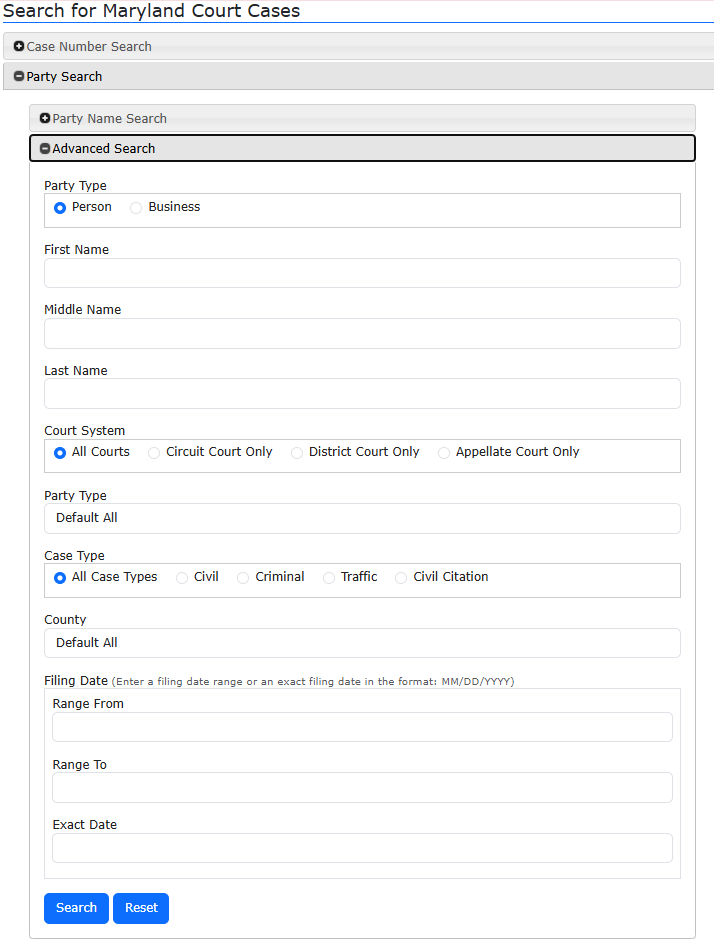
The Maryland Judiciary Case Search lets the public perform a case lookup for civil, criminal, and other court records online. It shows summaries of cases filed in Maryland courts, including those from Prince George’s County.
Online Guide:
- Open the Case Search Website:
Go to the official Case Search page at https://casesearch.courts.state.md.us/ in your web browser. - Agree to Terms/Complete CAPTCHA:
You may see a cookie notice or a CAPTCHA to confirm you’re human. Accept or complete this before proceeding. - Select Search Type:
You can search by:- Party Name (e.g., John Smith)
- Case Number (if known)
- Date Range (for date‑based lookup)
- County (pick Prince George’s County to narrow results)
- Enter Search Information:
- For name searches, use at least the first character of the last name followed by % (for partial matches) to get results.
- If you know the exact case number, entering it will return results faster.
- View Case Summary:
The system will list matching cases — including case number, parties, case type, filing date, and current status. - Explore Case Details:
Click on a case to see docket events, scheduled hearings, and public documents available for viewing. The online tool provides case summaries, not full court files.
In‑Person Search at the Clerk’s Office
If a document isn’t available online or you need a certified copy, visit the Clerk of Court records office in person. Public access is available during regular business hours:
- Location: Circuit Court Clerk of Court Office, 14735 Main Street, Upper Marlboro, MD 20772.
- Phone: 301‑952‑3655 for general inquiries.
Meet the Current Clerk of Court
The Prince George’s County Clerk of Court is Mahasin S. El Amin, Esq., who serves as the elected Clerk of the Circuit Court for Prince George’s County, Maryland. She is responsible for leading the Clerk’s Office in managing court records, supporting court administration, and ensuring the public receives reliable document services. Ms. El Amin holds the official title of Clerk and is the primary county official in charge of the office that processes and maintains court documents. Her position is a local, elected role established by Maryland law, and she occupies a central leadership place within the county’s judicial system.
Official Name & Title
Mahasin S. El Amin, Esq.
Clerk of the Circuit Court
Prince George’s County, MD
Short Biography & Background
Mahasin El Amin has served as Clerk of Court since December 3, 2018. She won election to the position and later secured a second term in November 2022, reflecting community support for her work and leadership. She attended local schools in Maryland, including the Thomas G. Pullen Creative and Performing Arts School and Suitland High School. Ms. El Amin then graduated from the University of Florida with a Bachelor of Science degree in public relations and earned her law degree (J.D.) from the University of Baltimore School of Law in 2009. After law school, she was admitted to the Maryland Bar and began her legal career. Prior to serving as Clerk, she worked as a law clerk for a Circuit Court judge and later practiced law both with the Maryland Legal Aid Bureau and in private practice. Her legal experience and service across multiple roles help inform her work leading the Clerk’s Office.
Career History & Professional Experience
Before becoming Clerk, Ms. El Amin worked:
- as a law clerk to a Circuit Court judge, where she gained firsthand experience with court procedures and judicial support;
- as a staff attorney at the Maryland Legal Aid Bureau; and
- as an associate attorney in private practice.
Years of Service & Roles
Ms. El Amin has been in office since late 2018 and continues to serve through her current term, which runs until October 31, 2027. She also holds leadership roles beyond the county, including serving as Secretary of the Maryland Circuit Court Clerks’ Association and participating in statewide judicial committees focused on court technology and access.
Key Priorities & Administrative Goals
These goals reflect a commitment to ensuring both the public and legal professionals can interact with the Clerk’s Office confidently and effectively. As Clerk, El Amin focuses on:
- improving timely, accurate court recordkeeping and document processing;
- providing excellent customer service to county residents;
- expanding efficient access to public records and filings;
- supporting the integration of electronic court services; and
- enhancing community outreach and legal support resources.
Service Initiatives, Community Engagement & Achievements
El Amin is actively involved in numerous community and professional organizations, including the Prince George’s County Alumnae Chapter of Delta Sigma Theta Sorority and various bar associations, demonstrating her commitment to civic engagement and collaboration beyond her official duties. Under her leadership, the office has continued to modernize, adopting best practices for recordkeeping, document retrieval, and public service. Her participation in state judiciary committees allows her to bring innovative approaches and improvements back to the county level, enhancing efficiency, transparency, and overall service to the public.
Services Provided by the Clerk’s Office
The Clerk’s Office in Prince George’s County plays a central role in filing services and handling court documents for a wide range of legal matters. This office supports residents, attorneys, and court staff by processing filings, providing access to records, and making sure official paperwork meets legal requirements. Whether someone is involved in a civil lawsuit, a criminal matter, a family case, or needs jury information, the Clerk’s Office helps make these tasks more efficient and clear. Below is a complete guide to the main document processing and court record services you can expect from the Clerk’s Office.
Civil Case Filings
When individuals or businesses start a civil lawsuit, the Clerk’s Office accepts and processes all related paperwork. Civil case filings include disputes over money, property, contracts, personal injury claims, and other non‑criminal matters. To begin a civil case, the filer should bring completed forms, required fees, and proper identification. Once accepted, documents become part of the public court record unless sealed by a judge.
What the Clerk’s Office does for civil cases:
- Receives initial complaint forms and petitions.
- Checks that paperwork meets court format standards.
- Assigns a case number and enters information into the record.
- Updates the docket as new filings arrive.
- Provides certified copies of pleadings and orders when requested.
Criminal Case Documents
The Clerk’s Office also manages records for criminal cases that go through the Circuit Court or District Court. Though law enforcement and prosecutors handle charging decisions, the Clerk’s Office files and tracks important court papers after a case enters the judicial system. Because criminal records involve legal rights and timelines, the Clerk’s Office tracks deadlines and makes sure documents are entered accurately and promptly.
Criminal case support includes:
- Recording indictments and information.
- Processing bail orders and arraignment documents.
- Entering court rulings, sentencing papers, and judgments.
- Providing certified copies of court orders for defense lawyers or defendants.
Family and Probate Filings
Family law and probate matters often require detailed forms and long‑term recordkeeping. The Clerk’s Office handles filings for these sensitive areas with care and accuracy. Specialized court procedures apply in family and probate cases, and the Clerk’s Office ensures paperwork conforms to those rules before accepting it for filing. Often, staff provide lists of forms or basic instructions to help users prepare correct documents.
Family law document processing includes:
- Marriage license filings.
- Divorce and separation papers.
- Custody and support case documents.
Probate and estate filings include:
- Petitions for administration of a deceased person’s estate.
- Will submissions for record.
- Inventory and accounting forms.
Public Access to Court Records
The Clerk’s Office is a primary source of public court records. Many documents become part of the public file once filed, and the office supports access through both online tools and in‑person services. Certified copies carry an official seal and are often required for legal, business, or personal matters outside the courtroom. Uncertified copies can sometimes be printed directly from public terminals or online systems. Note that certain records remain protected by law, including sealed orders, juvenile case files, and some family matter documents, and are only available with appropriate authorization.
Ways the public can access records:
- Online search via official court record databases.
- On‑site viewing in the records room.
- Requests for certified copies of judgments, orders, and case filings.
Jury Records and Summons
The Clerk’s Office also manages jury records and summons for county courts. Jury duty is an important civic duty, and the Clerk’s Office ensures that summonses are issued according to state rules and timelines. If someone has questions about their service dates or needs to update contact information, the Clerk’s staff can assist. This service includes:
- Generating jury duty notices.
- Maintaining lists of eligible jurors.
- Recording responses and attendance.
- Providing schedule updates for jurors.
Clerk Duties & Responsibilities
The Prince George’s County Clerk of Court office handles a wide range of clerk duties that ensure smooth operation of the judicial system while supporting the public. These duties combine administrative, legal, and customer service responsibilities, all rooted in state law and county procedures. Staff work with judges, attorneys, and residents to maintain accurate records, track case progress, and provide assistance.
Record Custodianship
One of the most important responsibilities is record custodianship. The Clerk’s Office manages official court files for civil, criminal, family, traffic, and probate cases. This custodianship ensures that documents remain accurate, protected, and easily retrievable for judges, attorneys, and residents. Duties include:
- Receiving and indexing all incoming court documents.
- Storing files securely while allowing access to public records where permitted.
- Providing copies or certified copies of documents upon request.
- Archiving older records for long-term preservation.
Case Tracking
Case tracking is a critical responsibility of the Clerk’s Office, beginning from the moment a case is filed. The office updates the docket with new filings, scheduled hearings, court orders, and final judgments to ensure that all procedural steps are properly recorded. Effective case tracking helps keep the judicial system organized, prevents delays, and ensures that legal processes run smoothly. Staff are responsible for monitoring deadlines and court schedules, ensuring that all parties receive timely notices and updates, and preparing documents for hearings while maintaining accurate records of all proceedings.
Public Assistance
Providing public assistance is a vital daily function of the Clerk’s Office, ensuring that individuals, attorneys, and the general public can access court services effectively. This support promotes transparency, improves access to justice, and helps users navigate often complex legal processes with confidence. By offering guidance, staff help prevent errors in filings, reduce delays, and ensure that procedural requirements are met. Public assistance also fosters better communication between the court and the community, making legal information more understandable and accessible. Staff provide help in various areas, including:
- Locating and retrieving court documents.
- Completing legal forms correctly for submission.
- Understanding procedures for civil, criminal, or family filings.
- Using online tools for searching public records or submitting documents.
Compliance & Regulations
The Clerk’s Office plays a key role in enforcing compliance with court rules and regulations, ensuring that all legal documents meet required standards. Maintaining compliance helps prevent errors that could delay cases or create legal complications. Staff responsibilities include checking submissions for completeness, proper signatures, and required attachments, recording fees and verifying payments for filings, and training personnel to maintain consistency in document processing. Additionally, the office stays updated on changes to court procedures and regulations, ensuring that all operations adhere to current legal requirements and support the smooth functioning of the judicial system.
Duties of the Current Clerk
As the current Prince George’s County Clerk of Court, Mahasin S. El Amin, Esq. oversees all office operations. Her leadership ensures that the Clerk’s Office operates efficiently and provides reliable support to both the judicial system and county residents. Her responsibilities include:
- Leading the team in record management, case tracking, and public support.
- Coordinating with judges, attorneys, and court staff for seamless operations.
- Representing the office on statewide committees for court administration and technology.
- Implementing service improvements and expanding resources for the public.
Fees, Forms & Filing Requirements
The Prince George’s County Clerk of Court manages all filing services and ensures court documents comply with state and local requirements. Understanding fees, forms, and filing procedures helps residents and legal professionals submit accurate paperwork efficiently. This section explains the fee breakdown, accepted payment methods, required forms for different case types, and where to download them. Clear instructions help prevent mistakes, reduce delays, and ensure filings meet legal standards. The Clerk’s Office enforces rules consistently and provides resources for self-represented litigants. Knowing what fees apply and which forms are needed saves time and avoids unnecessary trips to the courthouse.
Filing Fee Breakdown
All filings require fees, which vary depending on the type of case and whether an attorney is involved. These fees cover administrative costs and help maintain accurate, accessible records for the public and the courts. These fees ensure that filings are processed promptly, and that official documents remain valid and legally recognized. Additional charges may apply for appeals, special motions, or certain probate filings.
Below are typical fees for civil and family cases in Prince George’s County:
Civil Case Fees:
- Case Filing (Without Attorney): about $165
- Case Filing (With Attorney): about $175
- Certified Copies: $5
- Copies (per page): $0.50
- Voluntary Dismissal: $15
Family & Domestic Case Fees:
- Filing Motion or Complaint (Without Attorney): $165
- Filing Motion or Complaint (With Attorney): $175
- Certified Copies: $5
- Exemplification/Triple Seal: $10
- Voluntary Dismissal: $15
Accepted Payment Methods
The Clerk’s Office accepts multiple payment methods to make filings convenient for residents and legal professionals alike. It is important to check with the Clerk’s Office for any updates to payment options, especially if mailing payments or paying online. Proper payment ensures the filing is accepted without delay.
Payments can typically be made using:
- Cash (in person only)
- Check or money order payable to the Clerk
- Credit/debit cards (online portals may include a small processing fee)
- Electronic e-check/ACH payments via online services
Required Forms by Case Type
Different case types require specific forms to comply with Maryland law. Using the correct form is essential for a smooth filing process and prevents rejected submissions. The Clerk’s Office staff can guide users on where to obtain forms, but they do not provide legal advice. Using updated official forms ensures filings are accepted promptly and recorded correctly.
Common form categories include:
- Civil Actions: complaints, summons requests, motions, affidavits
- Family Law: divorce petitions, custody documents, support forms
- Criminal Filings: notice of appearance, plea documents
- Probate/ Estates: petitions for administration, wills, bond forms
Where to Download Forms
Most official e‑forms can be downloaded directly from the Maryland Judiciary’s website. This allows filers to complete forms digitally and ensures they are using the most current versions. Some Circuit Court-specific forms may also be available via the Clerk’s Office page or in-person at the courthouse. Having the correct forms ready helps avoid filing delays and additional trips to the office.
Official forms page:
https://www.courts.state.md.us/district/forms/formsinstruction
Overview of the Prince George’s County Clerk of Court
The Prince George’s County Clerk of Court office plays a central role in local justice by handling clerk duties and day‑to‑day court administration. This office manages official paperwork and supports the judicial process from the moment a case is filed until it is completed. Staff help judges, attorneys, and members of the public with accurate information and reliable services that keep county courts organized and running smoothly. The Clerk’s Office focuses on dependable legal record keeping and consistent service so that court activity is clear, accessible, and properly documented. Residents, lawyers, and community partners rely on this office for accurate filings, record retrieval, and assistance with procedural questions. Its work helps preserve public trust and supports fairness in the local justice system.
History and Mission of the Office
The Clerk’s Office in Prince George’s County has a long tradition of serving the public and the courts. From early record logging to modern digital systems, its mission has centered on trustworthy court management and accessible records for civil, criminal, and family cases. The office was established to serve as the official record custodian and has expanded its services as the county’s caseload and legal needs have grown. This mission ensures that the community and legal professionals have the tools and information needed for effective participation in the justice system, whether they are filing a case, looking up records, or preparing for a hearing.
The mission of the office includes:
- Managing court documents from filing through final disposition.
- Preserving official records for future review and legal reference.
- Helping citizens complete appropriate forms and understand requirements.
- Supporting judges by preparing dockets and organizing court files.
Key Functions of the Clerk’s Office
The Clerk supports multiple functions that help the courts operate efficiently. These activities are essential for accurate legal record keeping and help ensure that court activity remains open and orderly for the public and legal professionals alike. Staff accept and process filings in several major case categories:
- Filing civil, criminal, and family case documents
The office handles incoming paperwork for civil disputes, criminal charges, family law matters, and other legal actions. Each filing is logged, reviewed for completeness, and entered into the official court record. - Maintaining public records and court files
Official records, once accepted, become part of the public court files. The Clerk’s Office stores, organizes, and retrieves these records upon request, often providing certified copies when required for legal or personal use. - Managing jury summons and court schedules
The office also manages tools for summoning potential jurors and tracks schedules for hearings, trials, and other court events. Clear coordination of these functions supports timely court operations.
Role in the Judicial System
The Clerk works closely with multiple courts in Prince George’s County, including the Circuit Court, District Court, and Family Court divisions. Each court addresses different legal needs, and the Clerk ensures that records and schedules are prepared correctly for all of them. This coordination supports judges and court staff by providing organized, up‑to‑date case information and reliable administrative support. The Clerk’s Office is a cornerstone of court coordination and legal administration in the county.
- In Circuit Court, complex civil and serious criminal matters are documented and tracked with precision.
- In District Court, traffic cases and minor civil matters are processed and reflected in official records.
- In Family Court, sensitive filings like custody or support actions are managed with appropriate confidentiality and structure.
Location & Contact Information
The Prince George’s County Clerk of Court office is located in the heart of Upper Marlboro, Maryland, serving as the central hub for court documents, public inquiries, and official record requests. This county location is part of the Circuit Court complex where civil, criminal, family, and other case filings are processed and maintained. The office provides key services to residents, legal professionals, and community members who need access to public records or support with filings. You can contact the Clerk’s Office directly by phone, email, or in person during regular business hours.
Office Address & Contact Details
The Clerk of Court’s primary office is situated at the county’s courthouse:
Circuit Court – Clerk of the Court
14735 Main Street
Upper Marlboro, MD 20772
Phone: 301‑952‑3318
Toll‑Free (in Maryland): 800‑937‑1335
Fax: 301‑952‑3768
TTY: 301‑952‑3925
Email: ccct@co.pg.md.us
Office Hours & Customer Service
During business hours, citizens can visit the records counter, submit court documents, request certified copies, or ask questions related to fee schedules and case statuses. Many services can be initiated in person, by telephone, or in some cases through online portals maintained by the Clerk or the Maryland Judiciary. The Clerk’s Office operates Monday through Friday with consistent business hours that accommodate most public and professional needs:
- Office Hours: 8:30 a.m. – 4:30 p.m., Monday through Friday (closed on court holidays)
Frequently Asked Questions
The Prince George’s County Clerk of Court provides essential filing services and manages a wide range of court documents. Many residents and legal professionals often have similar questions about submitting forms, accessing records, paying fees, and understanding office procedures. This highlights common inquiries and offers clear, actionable answers to help users navigate court processes efficiently. Understanding these key points can save time, reduce errors, and ensure that filings and record requests are completed correctly.
How do I file a case in Prince George’s County?
To file a case, you first need to identify the correct type—civil, criminal, family, or probate. Obtain the appropriate court documents from the Clerk’s Office or download them online. Fill out the forms completely, including all required signatures and attachments. Submit the documents either in person at the Clerk’s Office or via authorized online filing systems. Filing fees must accompany your submission, which vary by case type and attorney representation. Once accepted, the Clerk assigns a case number, enters it into the docket, and provides confirmation of filing. Staff can guide you on forms and deadlines but cannot give legal advice. Accurate preparation ensures the case proceeds without unnecessary delays.
Can I access court records online?
Yes, many court records are available through the Maryland Judiciary Case Search portal. You can search by party name, case number, or filing date. The system provides access to case summaries, dockets, and certain documents. Sensitive filings such as juvenile cases, adoption proceedings, or sealed family records are restricted and require a court order for access. Using the portal, users can track case status, check hearing dates, and download public documents. This online service reduces the need for in-person visits. To access the official portal, visit: https://casesearch.courts.state.md.us/. Always verify details and fees before requesting certified copies of documents.
What are the fees for document filing?
Filing fees depend on the type of case. Civil case filings usually cost between $165 and $175, while family law filings follow a similar range. Certified copies of documents cost $5 each, and standard copies are typically $0.50 per page. Additional fees may apply for appeals, multiple documents, or special requests. Payments can be made with cash (in person), check, money order, or credit/debit card through approved online portals. Processing fees may apply for online payments. Fees help the Clerk’s Office manage court administration, maintain records, and provide efficient services. Always confirm current fees on the official website before submitting filings to avoid delays or rejected documents.
How do I get a certified copy of a divorce decree?
Certified copies must be requested either in person or by mail. You need to provide the case name, docket number, and filing date to ensure the correct document is retrieved. Each certified copy carries a fee and includes an official seal confirming its authenticity. These copies are necessary for property transfers, legal proceedings, or administrative purposes. Requests can be submitted using the Records Request form available on the Clerk’s website or at the office. Processing times vary depending on demand. Staff can confirm fee amounts and acceptance methods. This process ensures that your certified copy is legally valid and recognized by other agencies or courts.
Who do I contact for assistance with court forms?
For guidance on forms and court procedures, you can contact the Clerk’s Office. Staff can explain where to obtain forms, filing requirements, and submission instructions. They provide assistance with general procedural questions but cannot offer legal advice. Contact options include the main phone line at 301‑952‑3318, email at ccct@co.pg.md.us, or in-person visits at 14735 Main Street, Upper Marlboro, MD 20772. For complex legal matters, consult an attorney or certified legal aid service. Having questions answered by staff ensures that forms are completed correctly and filed in a timely manner, reducing the likelihood of rejection or delays.